
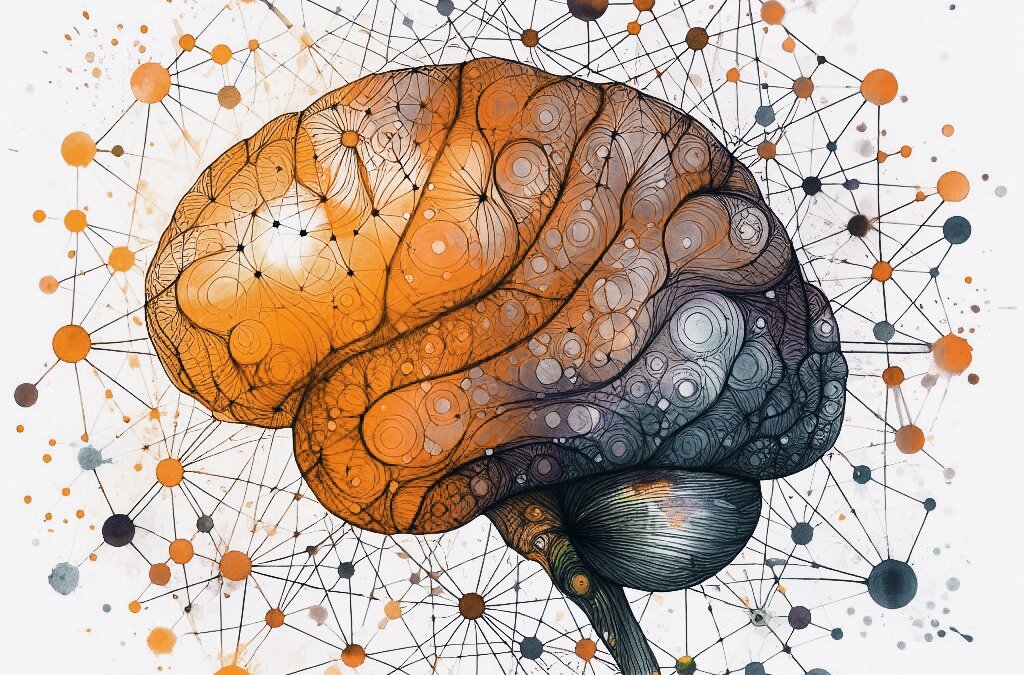
For years, the dominant model of the brain in Western neuroscience has been the triune brain theory—a framework that describes the brain as three evolutionary layers stacked upon one another, each with its own distinct function. This model, introduced by Paul MacLean in the 20th century, categorises the brain into the reptilian complex (instinctual survival responses), the limbic system (emotions and social behaviour), and the neocortex (higher reasoning and abstract thinking). While this approach provided a compelling narrative about brain evolution, it has largely been superseded by more dynamic, interconnected models of brain function .
In more recent years a profound shift has been emerging—one that moves beyond rigid, hierarchical divisions into a more morphic and holonic understanding of the brain’s activity. This more holistic networked approach is the basis of the newer Network Brain Framework. For myself, rather than viewing the brain as a set of discrete layers, I now percieve it as a networked system of holonic development, where each aspect is an evolving part of a greater whole. This perspective transforms not only how I understand brain function but also how I engage with learning, creativity, and consciousness itself.
The Shift from Static Layers to Morphic Fields
The triune model implied localised, static regions of the brain responsible for particular functions. However, research in neuroplasticity, embodied cognition, and complex adaptive systems now suggests a more fluid, morphic perspective—one where the brain’s functions are not fixed in discrete locations but emerge through dynamic patterns of connectivity.
From a holonic perspective, the brain is not merely an assembly of independent parts but an evolving system in which each level and layer of organisation—neurons, circuits, functional networks—operates as a nested holarchy, meaning that smaller systems (such as local neural circuits) contribute to larger, emergent processes (such as perception, cognition, and self-awareness). Each holon is both a whole unto itself and a part of a greater whole, continuously adapting to experience.
Rather than seeing brain activity as the output of separate layers, this model reveals a system of reciprocal influence, where perception, movement, and cognition are co-created through ongoing feedforward, feedthrough and feedback interactions.
Implications for Perception and Cognition
When we embrace a morphic-holonic model of the brain, several shifts in perception emerge:
- From Localisation to Distributed Functionality
- Instead of assigning functions to fixed brain regions, we recognise that cognition, movement, and perception arise from distributed dynamic networks that constantly reconfigure based on experience, context, and intent.
- For instance, rather than seeing the neocortex as the exclusive seat of higher reasoning, we can understand reasoning as an emergent activity of integrated sensory-motor, emotional, and cognitive processes.
- From Hierarchy to Holarchy
- The old model assumes a top-down structure where higher brain areas control lower ones. The new model reveals an interwoven process in which different layers of activity contribute in an evolving, reciprocal fashion.
- For example, rather than emotion being confined to the limbic system, we now see that emotional processing involves sensorimotor participation, predictive processing, and embodied awareness.
- From Fixed Wiring to Adaptive Patterning
- Neuroplasticity demonstrates that the brain is not hardwired but constantly reshaping its internal organisation based on experience, learning, and sensory engagement.
- This adaptability suggests that what we think of as cognitive intelligence is deeply interwoven with movement, somatic awareness, and our relational field—pointing to a far more participatory model of intelligence than traditional frameworks allow.
- From Brain-Centric to Embodied and Extended Cognition
- A holonic model of the brain aligns with the concept of embodied cognition, in which thinking is not isolated within the head but distributed throughout the body and environment.
- The nervous system, muscles, fascia, and even external tools (such as writings, movement practices, or creative expressions) can be seen as extensions of cognition, rather than separate from it.
Holonic Brain Development and Conscious Evolution
This shift has profound implications not just for neuroscience but for personal and collective evolution. If our cognition is morphic rather than static, then learning, creativity, and perception are not about acquiring fixed knowledge but about participating in an ongoing, dynamic process of emergence.
From a practical perspective, this involves:
- Engaging in movement-based learning (such as somatic practices, improvisational dance, and developmental movement) to expand cognitive function beyond conceptual thought.
- Recognising that intelligence is co-emergent—it unfolds not through isolated brain processes but through the interactions of perception, movement, and awareness.
- Approaching personal growth through holonic integration, where expanding awareness at any level (somatic, emotional, conceptual) ripples through the entire system, creating new possibilities for expression and action.
The Brain as a Living Field
If we move beyond the triune model into a holonic perspective, we no longer see the brain as a machine with separate parts, but as a living, morphic field of intelligence—a system that is always evolving, always integrating, and always participating in the larger flow of life.
This shift invites a fundamentally different relationship with learning and transformation—one that moves from acquiring knowledge to becoming the living expression of emergent intelligence.
Recent Comments