
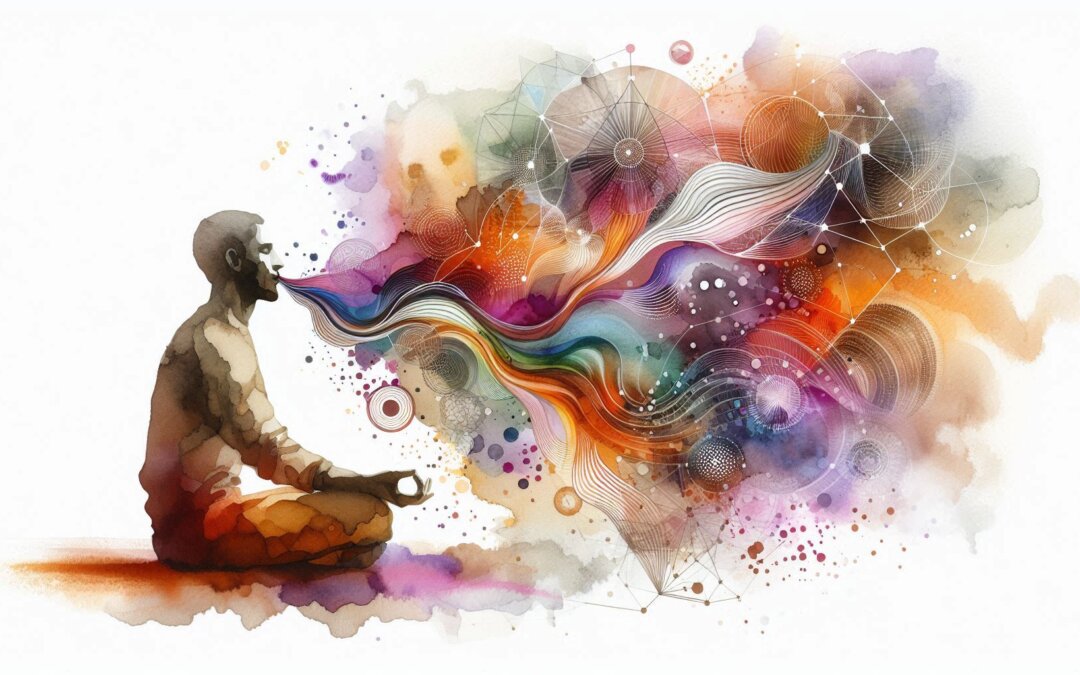
Breathing is far more than just the simple act of drawing air into the lungs and releasing it. It’s a living expression, a continuous flow of communication that moves through us every second, telling stories that shift as we do. With every breath, we’re engaging in an intricate conversation, not only with ourselves but with life itself. Like learning to speak, we can become attuned to the structure and subtle patterns of our breathing—its vowels, consonants, sentences, and pauses—and in doing so, we open new doorways into how we experience the world around us and within us.
In my own journey with the breath, I’ve come to realise that each breath holds within it a spectrum of possibilities. Breathing being so much more than what seems like a mechanical necessity; it’s a powerful creative animating action that shapes how we feel, think, move, and act. When we consciously tune into the breath, we enter a field of exploration that invites us to shift out of old, habitual patterns and step beyond them into new, more expansive states of being. This living language of breathing enabling us to rewrite the stories that had been unconsciously set on repeat, offering us the opportunity to create and express ourselves anew with every inhalation and exhalation.
The Four Vowels of Breathing
Let’s start by considering the ‘four vowels’ of this language. These core elements can be seen as the in-breath, the out-breath, and the two pauses between them—the stillness that rests at the top of the inhale and the bottom of the exhale. Each of these is present in every breath, though their presence and duration may vary according to our current state or circumstances.
The in-breath is a moment rich with potential, where we draw in the nourishment we need, filling ourselves with energy and life. The out-breath, conversely, is a release—a letting go of what is no longer required, a gift back to the world. Between these two actions, we find the pauses—those brief moments of stillness where the breath lingers, giving us a space to recalibrate, settle into the present, and prepare for what’s next.
These four elements form the foundation of our breath’s expression. Much like vowels in spoken language, they create the basic framework from which our breath flows. When we focus on these individual components, we start to become aware of the subtle shifts and variations in their quality. Is the in-breath short or expansive? Is the out-breath smooth or stifled? What happens in the spaces between breaths—are they rushed, or do they invite us into stillness? Each slight change offers us the opportunity to shift how we feel and experience the present moment.
The Consonants of Breath: Crafting Somatic Words
As we deepen our awareness, we begin to notice other qualities and characteristics in the language of breathing. This is where the breath starts to take on its unique texture, much like consonants give shape to words. We might start to ask, how does the breath enter the body? Through the nose, mouth, or both? What difference does it make to inhale through one nostril or the other? Is the breath flowing easily, or is there resistance? Do we feel the expansion in our chest, belly, or even across our ribs? What sensations accompany the breath—tension, ease, warmth, coolness?
These nuanced elements are like consonants, forming distinct patterns and rhythms when combined with the vowels of the breath. Just as spoken words come alive through the interplay of vowels and consonants, so do our breathing patterns shape our experience of life. A slow, deep in-breath followed by a long pause can evoke a sense of calm, while short, rapid breaths might create a sense of urgency or anxiety. By becoming curious about these patterns, we can start to craft our breath in new ways—shaping it like a somatic language that speaks directly to the body and soul.
Historical Narratives: The Story of Your Breath
For most of us, our breathing patterns are shaped by our personal history—an unconscious narrative that has been written over time, etched into our somatic memory. These stories are often influenced by past emotional experiences, habitual postures, environments we’ve lived in, and even the breathing patterns of those around us, from childhood onward. These influences create deeply ingrained patterns that can limit the full expression of our breath, and by extension, the way we live.
Take a moment to notice how you breathe. You may find that when you’re concentrating or stressed, you hold your breath, or when you’re physically active, your breathing becomes rapid and shallow. These are reflections of the historical story your breath has been telling, repeating itself over and over. Each breath you take today is an echo of past experiences—of stress, fear, joy, or even the simple routines of daily life.
But just like any story, this one is not fixed. We have the power to rewrite it. By becoming conscious of how we breathe and exploring different possibilities, we can alter the ongoing narrative. As we adjust the quality, rhythm, and length of our inhalations, exhalations, and pauses, we can release the old stories that no longer serve us and begin to script new ones. In doing so, we free ourselves from the limiting patterns of the past and open to more expansive, dynamic ways of experiencing life.
Unveiling New Stories Through Breath
One of the most profound shifts I’ve experienced in my own experience with the language of breathing has been through recognising and changing my breathing patterns. I discovered that my breath had become restricted, following a narrow, predictable path that I didn’t even question. But through exploration, I began to notice subtle variations in my breath—the length of my in-breath, the sensation of holding the pause, the depth of my out-breath—and how these variations impacted my sense of wellbeing, energy, and presence.
By playing with these elements—extending the pauses, allowing my out-breath to become longer and more complete, shifting the timing of each inhalation and exhalation—I realised that I could co-create entirely new stories using the language of breathing. I wasn’t bound by the old narratives of shallow or restricted breathing. Instead, I had the ability to craft new rhythms, new patterns that allowed me to move through life with greater freedom, ease, and vitality.
This is the beauty of the breath: it is both expressive and adaptable. Each breath is a new opportunity to create, to express, to live more fully in the moment.
Composing New Life Experiences with Breath
The ‘Language of Breathing’ becomes a powerful tool for scripting new life options when we approach it with conscious awareness. Every breath holds within it the potential for a new chapter, a fresh beginning. By playing with the different elements of the breath—the balance between inhalation and exhalation, the stillness in between, the speed, depth, and texture of each breath—we open up new ways of interacting with the world around us and the world within us.
Imagine what it would feel like to breathe more freely, more expansively, engaging different parts of your body—your belly, chest, ribs, neck, or head—while changing the pace or depth of your breath. A longer in-breath followed by a shorter out-breath, or perhaps extending the pause between breaths, can bring about profound changes in your state of awareness and your relationship with life. The breath becomes a dance, a flowing rhythm that harmonises with your inner being and the outer world, creating new experiences that align with your evolving self.
As we unravel the old patterns that have shaped our breath up until now, we unlock new possibilities for how we can live, move, and feel. We no longer need to be constrained by the historical stories of our breathing—stories of shallow, constricted, or rapid breath. Instead, we have the freedom to compose our own breath patterns, rhythms that support our overall wellbeing, creativity, and connection to life itself.
Expanding Your Vocabulary in the Language of Breathing
If this approach to breathing resonates with you, I encourage you to begin your own exploration. The breath is one of the most adaptable and expressive aspects of your being, and by learning to speak its language fluently, you can access deeper layers of your somatic wisdom. This allows for more aligned communication and co-creation with life itself.
For those who feel drawn to take this exploration further, we’ve also written a Breath Flexibility blog post, which delves even deeper into how you can begin playing with your breath patterns. It’s a wonderful way to experiment with the possibilities available to you through breath, helping you break free from old narratives and establish new rhythms that support your ongoing evolution.
If you haven’t already, I invite you to try our free SomaBreathe Taster Course, which guides you through a process of discovery focused on the four fundamental aspects of breathing—the in-breath, the out-breath, and the two pauses. Through this course, you’ll uncover simple yet profound possibilities within your breath, guiding you into deeper states of presence and awareness, enhancing how you experience your body and life. Check it out here.
Ready to Go Deeper?
For those ready to take their breath practice even further, I’m thrilled to introduce our New 4 week Pranaleela Course which will commence Sunday 19th January 2025 . This new course moves beyond basic breathwork into the forgotten layers of your breath as a living, sensual landscape. You’ll explore how to engage different areas of your body, work with varying qualities and durations of the breath, expanding on basic Yogic Breathing patterns to awaken new ways of experiencing your breath. Contact us here to express interest and/or be told when full details for the course become available.
So if you’re ready to script a new story with your breath and compose fresh, somatic experiences, we look forwards to you joining us. Let’s explore how breathing differently can lead to living differently, how crafting your breath can open up new ways of interacting with life and yourself….
Recent Comments